


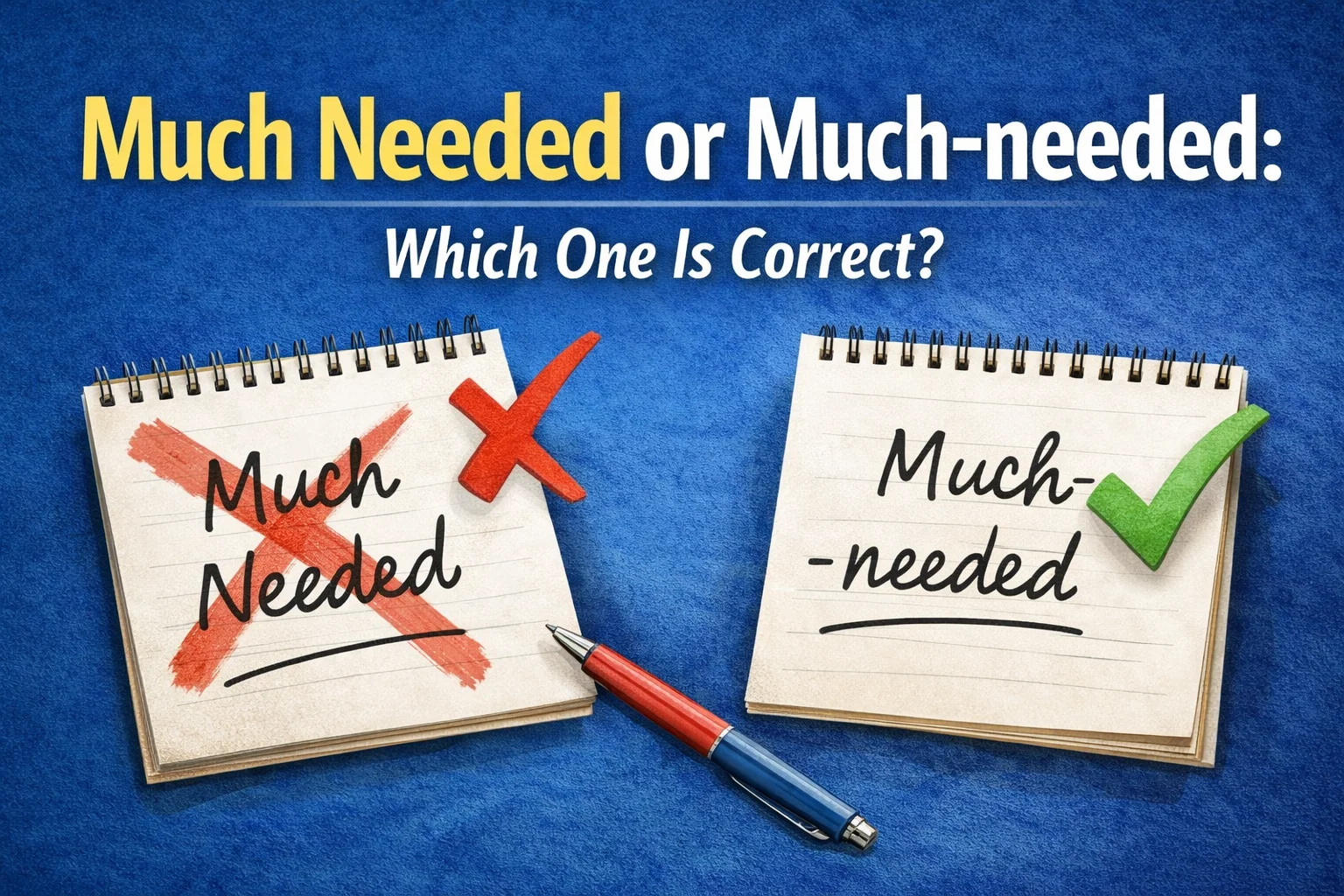
English can be tricky sometimes. Small details can change the meaning of a sentence. One common confusion people face is “much needed or much-needed.”
Both forms appear in writing. That is why many learners feel unsure. Should you use a hyphen or not? Does it change the meaning? Is one of them wrong?
The good news is that the answer is simple once you understand the rule. In this guide, you will learn the difference between much needed or much-needed, when to use each one, and how to avoid common mistakes.
We will also look at real examples, easy explanations, and helpful tables. By the end, you will feel confident using these phrases in daily writing.
Understanding the Phrase “Much Needed”
The phrase much needed describes something that is very necessary. It shows that something is required badly or urgently.
For example:
- I needed a much needed break after the long meeting.
- The rain was much needed after weeks of heat.
- The team received much needed support from fans.
In these sentences, much means “very,” and needed means “required.” Together they emphasize strong need.
This phrase is common in both spoken and written English. People use it when talking about rest, help, change, or improvement.
Sometimes writers add a hyphen and write much-needed. Other times they leave it without one. The difference depends on grammar structure, which we will explain next.
The Key Difference Between “Much Needed” and “Much-needed”
The difference between much needed or much-needed mainly depends on how the phrase is used in a sentence.
- Much-needed (with a hyphen) is used before a noun as a compound adjective.
- Much needed (without a hyphen) is used after a verb or when the phrase stands alone.
In simple terms, the hyphen connects the words when they work together to describe a noun.
For example:
- The team received a much-needed victory.
- After the project, I took a much-needed vacation.
Here, the phrase directly describes the noun.
But when the phrase appears later in the sentence, the hyphen usually disappears.
Example:
- The break was much needed.
- The help was much needed.
This small change helps sentences look cleaner and easier to read.
When to Use “Much-needed” (With Hyphen)
Use much-needed when the phrase appears before a noun. In this case, it acts like a compound adjective.
A compound adjective is two words joined by a hyphen that describe a noun together.
Examples:
- The city received much-needed rain.
- She took a much-needed rest.
- The company made a much-needed change.
In each example, the phrase directly modifies the noun that follows it.
The hyphen helps readers understand that the words belong together. Without it, the sentence might feel confusing.
Many professional writers prefer this style in formal writing because it follows standard grammar rules.
When to Use “Much Needed” (Without Hyphen)
Use much needed without a hyphen when the phrase appears after the noun or verb.
In these situations, the phrase describes something but does not directly sit before the noun.
Examples:
- The support was much needed.
- The rest was much needed after the long trip.
- The change was much needed for the company.
Here, the phrase works like a description rather than a compound adjective.
Because it does not directly modify the noun, the hyphen is not necessary.
This rule helps keep sentences simple and natural.
Quick Comparison Table
The table below shows the difference between much needed or much-needed in a clear way.
| Usage Type | Correct Form | Example |
|---|---|---|
| Before a noun | Much-needed | She took a much-needed break. |
| After a verb | Much needed | The break was much needed. |
| As a compound adjective | Much-needed | They made a much-needed improvement. |
| As a description | Much needed | The improvement was much needed. |
This simple rule solves most confusion about the phrase.
Why Hyphenated Words Matter in English
Hyphenated words exist to improve clarity. They help readers understand that certain words work together.
Without hyphens, some sentences could be confusing.
For example:
- A much needed break
- A much-needed break
Both may look similar. But the second one clearly shows that the words act as one description.
Hyphens often appear in compound adjectives such as:
- Well-known author
- Long-term plan
- High-quality product
- Much-needed support
These small marks make writing easier to read and understand.
Real-Life Examples in Everyday Writing
To better understand much needed or much-needed, let’s look at some real situations.
Imagine someone working long hours all week.
They might say:
“This weekend is a much-needed break.”
Later they might say:
“That break was much needed.”
Both sentences are correct. The difference is only the placement in the sentence.
Here are more everyday examples:
- The community received much-needed funding.
- The funding was much needed.
- She gave him much-needed advice.
- The advice was much needed.
You will notice the same pattern each time.
Common Mistakes People Make
Many writers confuse much needed or much-needed because they forget the placement rule.
Here are common mistakes:
Incorrect:
- The team received much needed help.
Correct:
- The team received much-needed help.
Another mistake happens when people add a hyphen after the noun.
Incorrect:
- The help was much-needed.
Correct:
- The help was much needed.
Remember this easy trick:
- Before a noun = use hyphen
- After a verb = no hyphen
This rule solves most grammar issues with this phrase.
Another Helpful Table With Examples
Here is a second table with more examples to make things clearer.
| Sentence Position | Correct Example | Explanation |
|---|---|---|
| Before noun | We enjoyed a much-needed vacation. | Phrase describes “vacation.” |
| Before noun | The company made a much-needed update. | Works as compound adjective. |
| After verb | The vacation was much needed. | Phrase comes after verb. |
| After verb | The update was much needed. | No hyphen required. |
If you follow this pattern, your writing will stay correct and natural.
Why Writers and Editors Prefer the Hyphen Rule
Professional writers follow grammar guidelines to keep text clear.
Style guides like the AP Stylebook and Chicago Manual of Style often recommend using hyphens in compound adjectives before nouns.
This rule helps avoid confusion and improves readability.
For example:
- A much-needed solution is clearer than a much needed solution.
Readers instantly see that both words describe the noun.
When writing articles, blogs, or academic content, using the correct form builds trust with readers.
It also improves SEO and readability.
Tips to Remember the Rule Easily
If you often forget much needed or much-needed, these tips will help.
First, check the position of the phrase in the sentence.
If the phrase comes before a noun, use the hyphen.
Example:
- much-needed help
If it comes after the verb, skip the hyphen.
Example:
- the help was much needed
Another tip is to read the sentence aloud. If the words clearly describe the noun together, the hyphen usually belongs there.
With practice, the rule becomes automatic.
Frequently Asked Questions
1. Is it “much needed” or “much-needed”?
Both are correct.
Use much-needed before a noun and much needed after a verb.
2. Is “much-needed” grammatically correct?
Yes, much-needed is correct when it acts as a compound adjective before a noun.
Example:
- The team earned a much-needed win.
3. Can I write “much needed break”?
In formal writing, it is better to write much-needed break because the phrase comes before the noun.
4. Why do we use a hyphen in “much-needed”?
The hyphen shows that the two words work together as one description.
It helps readers understand the meaning quickly.
5. Is “much needed” informal?
No, it is not informal.
It simply appears after the verb instead of before the noun.
Example:
- The rest was much needed.
6. Are there similar hyphenated phrases?
Yes, English has many compound adjectives.
Examples include:
- well-known author
- long-term plan
- high-quality product
- full-time job
These follow the same hyphen rule.
Final Thoughts
Understanding much needed or much-needed is easier than it seems.
The rule is simple:
- Use much-needed before a noun.
- Use much needed after the verb.
This small grammar detail helps make writing clearer and more professional.
Whether you are writing emails, articles, or social media posts, using the correct form builds trust with readers.
Over time, this rule will feel natural. Soon you will use much needed or much-needed correctly without even thinking about it.
And remember, clear writing always makes communication better.
